Crossing thirty changes the way your body responds to heavy physical training, but learning how to build muscle over 30 without joint pain is entirely possible with the right approach. What worked in your early twenties might now result in stubborn shoulder aches, lower back stiffness, or nagging knee pain. Building impressive lean muscle after thirty requires a smarter, intent-driven approach to workout programming.
You do not need to push through joint pain to trigger muscle growth and build functional strength. Understanding the biological shifts after thirty helps you make better decisions inside the weight room. Smart programming allows you to gain muscle continuously while keeping your joints protected and pain-free.
The Science of Muscle Growth and Joint Safety After 30
Your joints, tendons, and connective tissues take longer to recover as recovery speed and natural hormone levels decline. Heavy lifting with poor mechanics quickly leads to chronic inflammation instead of productive muscle hypertrophy. Focusing on controlled movement patterns keeps the mechanical tension strictly on the targeted muscle fibers.
Protecting your structural joints ensures long-term consistency, which remains the single most important factor for muscle gain. Selecting joint-friendly exercise variations allows you to train with high intensity without compromising structural integrity. Smart exercise selection builds a strong foundation that supports athletic performance and long-term joint health.
Prioritizing muscle isolation over ego lifting protects your cartilage from unnecessary friction and wear. Directing tension into the belly of the muscle creates maximum hypertrophy with minimal joint impact.
Optimizing Progressive Overload Without Excessive Heavy Weights
Progressive overload does not always mean adding more heavy iron plates to the barbell every single week. Increasing repetition quality, slowing down eccentric phases, and shortening rest intervals effectively force muscle adaptions. High-tension training techniques stimulate muscle growth while keeping the overall joint stress completely manageable.
Working within higher rep ranges of eight to fifteen repetitions produces excellent hypertrophy with minimal injury risks. Focus on mastering the mind-muscle connection during every single repetition of your working sets. Perfect execution drives maximum muscle fiber recruitment without exposing your joints to dangerous spinal compression.
Using slower tempo control forces your muscle fibers to work harder through the full range of motion. Controlling the movement eliminates momentum, which is the leading cause of sudden joint strains.
Designing an Effective Weekly Strength Training Split
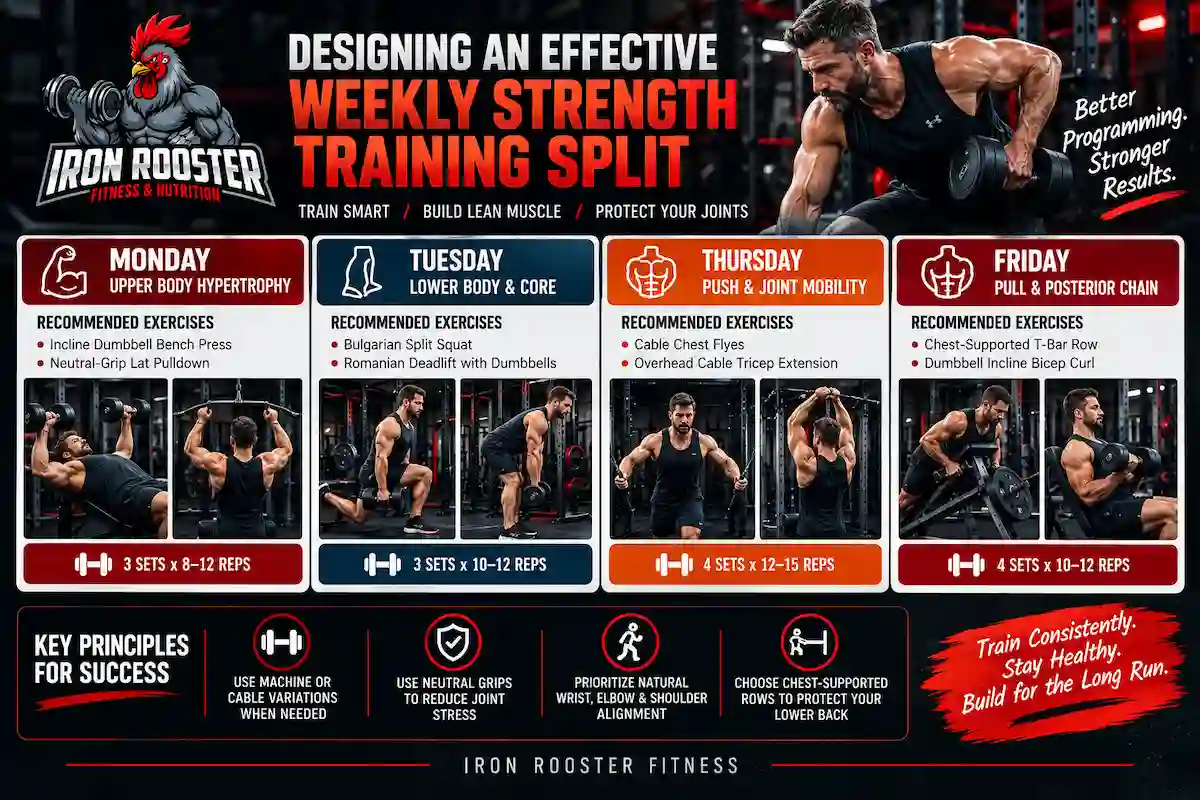
A balanced four-day upper and lower body split provides optimal training frequency and structural recovery time. This distribution ensures adequate resting windows so your central nervous system and joints recover fully between sessions.
Incorporate machine-based or cable-based exercise variations whenever free weights create joint discomfort. Cables maintain continuous resistance across the movement while minimizing awkward rotational stress on your shoulders. Always prioritize training movements that allow a natural wrist, elbow, and shoulder alignment throughout execution.
Using neutral grips during pressing and pulling exercises significantly reduces stress on vulnerable shoulder sockets. Chest-supported rowing variations take the pressure off your lower back while allowing maximum back contraction. This structural setup lets you train heavy without risking lumbar spine fatigue or lower back pain.
Daily Mobility Routines and Dynamic Warm-Ups for Lifters Over 30
Skipping a thorough warm-up session is no longer an option once you cross the age of thirty. Dynamic mobility work increases synovial fluid production within joint capsules to lubricate movement paths effectively. Spend ten minutes activating your glutes, upper back, and rotator cuffs before handling heavy working loads.
Target specific tight areas with light resistance bands to prep your body for deep ranges of motion. A proper dynamic warm-up raises core body temperature and prepares your central nervous system for work. This single habit dramatically improves workout quality while keeping joint irritation at absolute zero.
Integrating foam rolling before workouts helps release tight fascia and improves overall muscle tissue quality. Releasing myofascial tightness allows your joints to move freely without restricted ranges of motion.
Focus on joint-specific mobility drills like thoracic spine rotations and hip openers before heavy lifting. Unlocking mobile thoracic spine movement protects your lower back during complex pressing and pulling patterns.
Nutrition, Hydration, and Natural Hormone Support for Fast Recovery
Building lean muscle after thirty requires precise nutritional support to reduce systemic inflammation and speed repair. Prioritize adequate daily protein intake alongside healthy essential fats to maintain optimal natural hormone production. Hydration plays a critical role in keeping joint cartilage cushioned and resilient during heavy training sessions. Drink plenty of water throughout the day to support cellular recovery and maintain smooth joint movement.
Incorporate anti-inflammatory whole foods like omega-3 rich fish, berries, and leafy green vegetables into daily meals. Proper nutrition accelerates tissue repair so you return to the gym feeling fresh and fully recovered. Getting seven to eight hours of quality sleep every night is mandatory for joint repair and hormone synthesis.
Sleep is the primary window when your body releases growth hormone and repairs micro-tears in connective tissue. Supplementing with collagen peptides and glucosamine supports joint cartilage health and reduces exercise-induced joint soreness. Consistent supplementation gives your connective tissues the raw building blocks needed for long-term durability.
How to Adjust Your Training Plan When Joint Pain Starts
Ignoring minor joint aches eventually turns temporary discomfort into severe chronic injuries that stall all progress. The moment you feel joint sharp pain, swap the exercise for a painless mechanical alternative. Reducing the weight load and increasing time under tension allows you to maintain workout intensity safely.
You can stimulate muscle hypertrophy by utilizing metabolic stress techniques like drop sets and rest-pause sets. Listen closely to your body signals and take scheduled deload weeks every six to eight weeks. Deloading reduces volume and intensity, giving your joints, tendons, and nervous system time to rebuild completely.
Frequently Asked Questions
Can you build muscle after 30 without heavy weights?
Yes, focusing on mechanical tension, slow tempo control, and higher repetition ranges builds lean muscle safely without stressing your joints.
How often should men over 30 strength train each week?
Training three to four days per week provides the ideal balance between intense training stimulus and full joint recovery.
What is the best way to stop joint pain while lifting?
Use neutral grips, control the eccentric phase of every rep, and prioritize dynamic mobility work before every workout session.
Smart Strategies to Build Muscle Over 30 Without Joint Pain
By applying these progressive overload principles, you can consistently build muscle over 30 without joint pain and maintain peak athletic performance for years to come.